
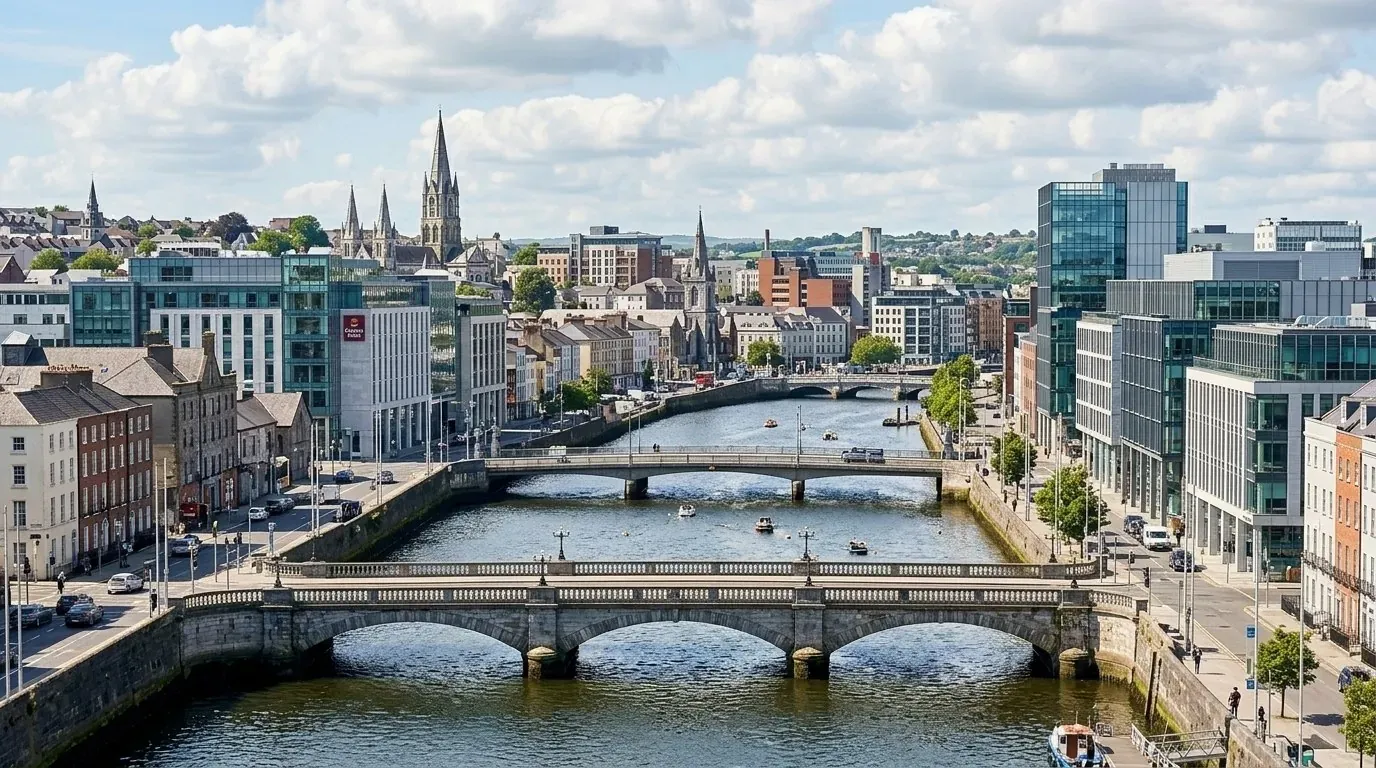
Cork is Ireland’s fastest-growing employment hub, offering global career opportunities with lower living costs and shorter commutes than Dublin. As Europe’s leading biopharmaceutical manufacturing hub and Ireland’s green energy gateway, Cork provides international professionals with direct access to decision-makers and rapid career mobility.
1. The Capital Trap: Why International Talent Looks South
When international professionals begin their job search in Ireland, their default focus is almost always Dublin. While the capital houses prominent European technology headquarters, it also presents severe structural hurdles: an acute accommodation bottleneck, extended transit times, and an oversaturated applicant pool where resumes frequently get lost in automated filters.
Just two and a half hours south, Cork has established itself as the country’s most resilient regional economy. Backed by the proactive initiatives of the Cork Chamber business network, the region is undergoing its largest commercial expansion in decades. Cork is not a secondary backup plan; it is Ireland’s industrial powerhouse, responsible for a significant share of national exports across pharmaceuticals, food technology, and offshore marine engineering.
To see how regional skills initiatives support arriving talent, explore our active programs in Cork connecting international specialists directly with local enterprise hubs.
2. Key Industry Sectors Driving Cork's Employment Market
Rather than competing with Dublin across general services, Cork dominates in specific high-value disciplines defined within Ireland's high-demand sectors:
- Life Sciences & Biopharma: Six of the world’s top ten pharmaceutical enterprises—including Pfizer, Janssen, Eli Lilly, and Novartis—operate advanced manufacturing and process research campuses in Ringaskiddy and Little Island.
- Cybersecurity & Cloud Infrastructure: Cork hosts Cyber Ireland’s founding cluster, supported by global names like Trend Micro, Dell Technologies, and Qualcomm developing enterprise software and cloud resilience.
- Green Energy & Maritime Innovation: As Ireland expands offshore wind operations, Cork Harbour—the second-largest natural harbour in the world—serves as the primary operational base for sustainable engineering and logistics.
3. Dublin vs. Cork: Pragmatic Career Comparison (2026 Data)
- Average Monthly Rent — Dublin Metropolitan Area: €2,350+ (High pressure zone); Cork Metropolitan Area: €1,750 – €1,900 (18–22% lower)
- Average Daily Commute — Dublin Metropolitan Area: 52 minutes (Congested corridors); Cork Metropolitan Area: 24 minutes (High walkability)
- Industry Dominance — Dublin Metropolitan Area: Big Tech HQs, Fintech, Legal; Cork Metropolitan Area: Biopharma, MedTech, Green Energy
- Networking Density — Dublin Metropolitan Area: Dispersed, formal, transactional; Cork Metropolitan Area: Compact, high peer visibility
- Career Re-entry Speed — Dublin Metropolitan Area: Slower due to high ATS volume; Cork Metropolitan Area: Faster through regional community
4. The Visibility Advantage: Fast-Tracking Your Professional Integration
The fundamental difference between building a career in Dublin versus Cork comes down to community scale.
In large metropolitan centres, international applicants often struggle with the impersonal nature of digital job boards, facing issues like the ATS filters detailed in our guide on how to write an Irish-style CV. In Cork, business and civic ecosystems are interconnected. Attending a regional meetup, joining an industry seminar, or participating in a community initiative frequently puts you in direct conversation with hiring directors and senior engineering leads.
Establishing a presence through verified local contributions allows skilled arrivals to bypass unverified barriers and demonstrate cultural fluency within the principles of navigating Irish workplace culture.
5. Frequently Asked Questions (FAQ)
Is Cork better than Dublin for international job seekers?
Yes, particularly for specialists in engineering, pharmaceuticals, and operations seeking higher disposable income, shorter commutes, and closer access to industry networks.
What industries are driving job growth in Cork in 2026?
Life sciences, process validation, cybersecurity, and marine green energy represent Cork’s fastest-growing employment fields.
How does the cost of living in Cork compare to Dublin?
Housing costs and daily expenses in Cork are approximately 18% to 25% lower than in Dublin, while technical salary packages remain competitive on a national scale.
Take the Next Step in Cork
Evaluating regional career opportunities starts with objective benchmarking.
- Map your credentials: Take the Confidence Compass to measure your profile against regional employment standards.
- Explore verified roles: Browse open positions across Cork and Ireland in our External Opportunities directory.
- Connect with local initiatives: Discover community-driven pathways on our Get Involved page.