Irish workplaces operate on egalitarianism, indirect feedback, and high relational trust. Direct hierarchy is deliberately downplayed, critical feedback is softened using polite hedges, and professional credibility depends on modesty and social rapport built around the tea station or casual humor. Success requires reading between the lines and prioritizing team consensus over aggressive self-promotion.
1. The Paradox of the "Friendly" Office
You arrive at your new corporate role in Dublin Docklands, an engineering campus in Little Island Cork, or a MedTech hub in Galway. You carry impeccable academic credentials mapped to the Irish NFQ system. Your technical expertise is unquestioned.
Your team leader greets you wearing casual attire, insists you call them by their first name, and immediately offers to make you a mug of tea.
At first glance, Irish workplace culture seems effortlessly relaxed. There are few visible symbols of status, doors remain open, and colleagues banter freely across desks.
Yet after a few weeks, an uneasy friction often sets in for global professionals. You gave direct, factual critique on a flawed code deployment or process flow, and the room suddenly went ice-cold. Or your manager remarked, "Maybe take another look at that report if you get a second," which you treated as a low-priority suggestion—only to discover later that it was an urgent directive.
Welcome to the unwritten operating system of corporate Ireland.
Thriving in an economy driven by high-demand employment sectors requires understanding that warmth is not a lack of rigor. It is the cultural currency through which trust and alignment are negotiated, reflecting our commitment to dignity and mutual respect.
2. Decoding the Hierarchy: Flat on the Surface, Consensus at the Core
Coming from business cultures characterized by clear command-and-control structures (such as Germany, South Asia, or parts of East Asia and the Middle East), the Irish workplace can feel disorientingly horizontal.
Senior directors sit in the same open-plan floor as graduate interns. Junior team members openly challenge operational points during sprint retrospectives.
However, "flat" does not mean "structureless":
- Consensus-Driven Authority: Decisions are rarely decreed from the top down without quiet, pre-meeting alignment. A manager will test an idea over casual coffee chats before formally presenting it to the team.
- The Taboo of Self-Aggrandizement: The fastest way to alienate Irish colleagues is to boast about personal accomplishments, elite university degrees, or former corporate titles. Humility is non-negotiable. If you performed exceptional work, allow your team and your data to articulate the results for you, as demonstrated in our guide on how to frame international experience.
- The Equality Ethos: Treating support staff, facilities personnel, or contractors differently from executive directors is regarded as an unforgivable cultural misstep.
3. Hiberno-English Decoding Matrix: What Is Said vs. What Is Meant
- "I’m not sure that’s entirely the best direction to take." — What It Actually Means: "That idea will not work; rethink your approach immediately."; Recommended Response Strategy: Do not debate aggressively. Pause, ask for input: "How would you frame it?"
- "Maybe have another glance at that when you get a second." — What It Actually Means: "This contains critical errors; fix it before the next project sprint."; Recommended Response Strategy: Treat this as high urgency. Revise the document and follow up swiftly.
- "I’ll leave that with you." — What It Actually Means: "You have full accountability and delivery responsibility for this."; Recommended Response Strategy: Confirm ownership in writing with explicit milestones and deadlines.
- "That’s grand." — What It Actually Means: "Everything is fine / agreed / no further changes required."; Recommended Response Strategy: Acknowledge and move forward; no need to keep over-explaining.
- "No worries at all!" (After a favor) — What It Actually Means: "You are welcome; social balance and collegiality are restored."; Recommended Response Strategy: Acknowledge with a warm smile; avoid stiff or formal apologies.
4. The 4 Pillars of Workplace Integration in Ireland
To bridge cultural divides and establish yourself as an indispensable contributor, focus on mastering four interpersonal behaviors:
1. The Ritual of the "Tea Station"
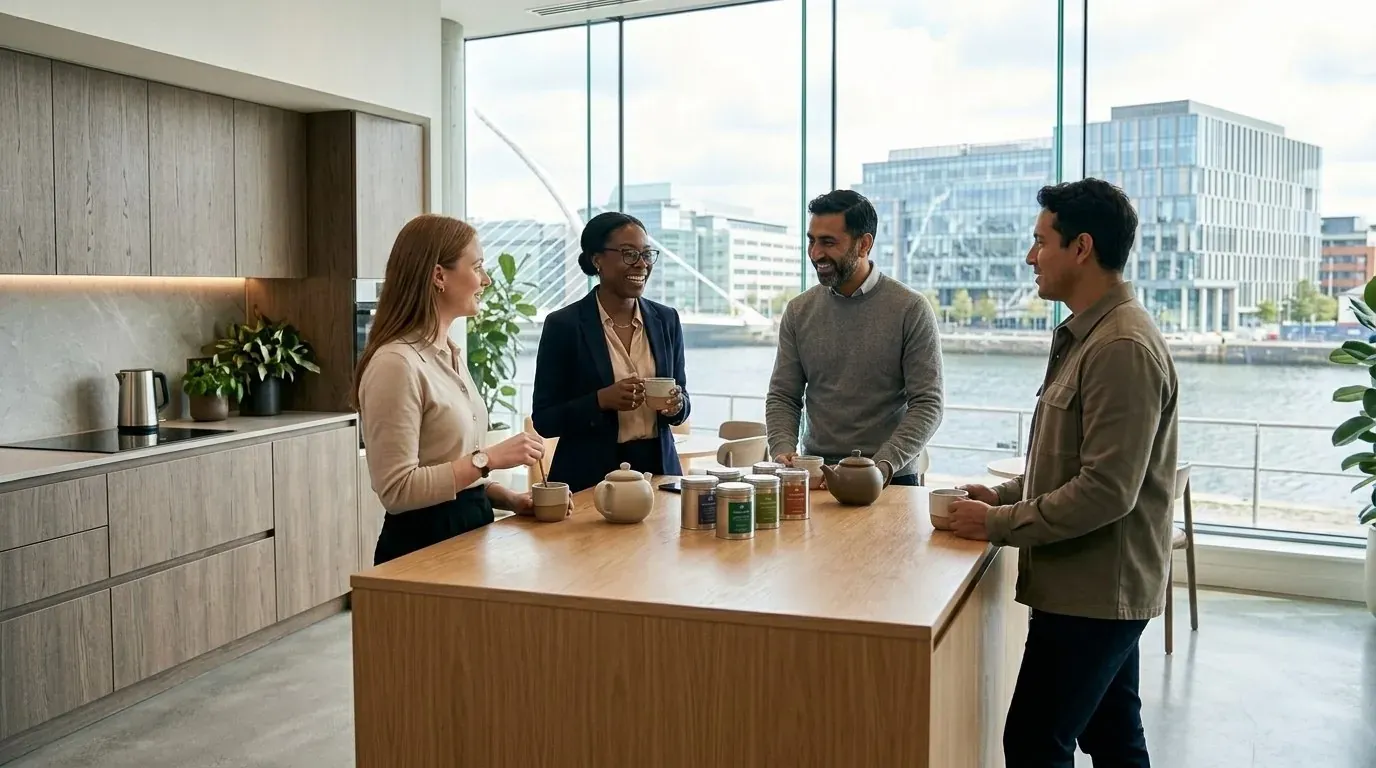
The office kettle is not just an appliance; it is an egalitarian social mixer. When you make tea or coffee, offer a cup to those sitting nearby ("Putting the kettle on, anyone want anything?"). Turning down social tea repeatedly can unintentionally signal detachment. Participating in these small rituals signals collegiality, which protects against the isolation examined in our 90-day culture shock framework.
2. The Art of "Constructive Banter"
Humor and light self-deprecation in Irish corporate life are not signs of unprofessionalism; they are de-escalation tools. When deadlines tighten or systems crash, teams lean into humor to relieve tension and preserve psychological safety. Being teased gently about minor habits is often a sign of affection and acceptance. Learn to laugh at yourself and avoid taking dry wit as personal hostility.
3. Softening Direct Feedback
Direct, blunt criticism is experienced in Ireland as aggressive and disruptive to team harmony. When providing technical critique, wrap it in a softened bridge:
- Instead of: "This architecture will fail under load."
- Try: "I'm wondering if we might hit scaling friction here under heavy traffic. Could we explore a load-balancer buffer together?" This protects your colleague's dignity while addressing the technical defect, echoing the communication shifts detailed in decoding Irish business communication.
4. Navigating the "Meeting Before the Meeting"
Major decisions in Irish organizations are rarely finalized during large, formal gatherings. They are socialized beforehand through brief hallway check-ins and one-on-one catch-ups. If you want support for a new initiative, speak with key stakeholders individually beforehand to resolve concerns quietly, rather than surprising the room, as seen in Elena's journey to corporate director.
5. Frequently Asked Questions (FAQ)
What is the most common culture shock for international professionals in Irish workplaces?
The unexpected combination of flat, informal hierarchies with indirect communication. Hierarchy is downplayed, criticism is softened, and professional trust is built socially rather than solely through formal credentials.
What does an Irish colleague mean when they say 'That's grand' or 'I'll leave that with you'?
"That’s grand" indicates satisfaction or agreement. "I’ll leave that with you" means you have full ownership of the deliverable. Expressions like "I’m not sure about that" usually represent polite but firm disagreement.
Why is the tea station so important in Irish companies?
The tea station is a horizontal networking space where corporate titles disappear. Participating in informal tea rounds demonstrates collegiality, builds rapport, and enables consensus to form naturally.
Thrive in the Irish Corporate Landscape
Understanding unwritten cultural conventions transforms technical proficiency into enduring leadership capital.
- Audit your workplace readiness: Take the Confidence Compass diagnostic to benchmark your communication and professional skills against active Irish standards.
- Explore supported career pathways: Browse vacancies across inclusive employers on our External Opportunities directory.
- For employers and HR teams: Discover how your organization can Partner with DGS on corporate inclusion to scale cultural intelligence across diverse squads.