
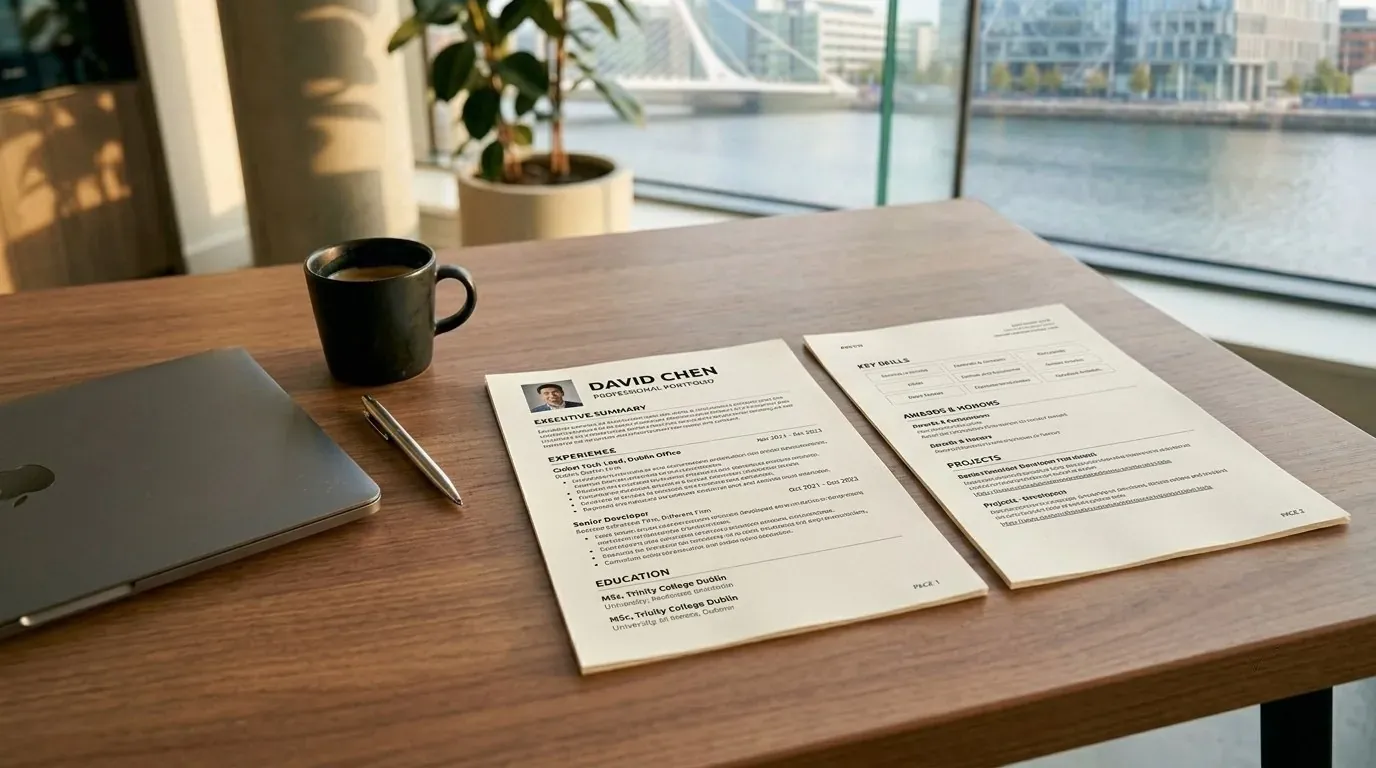
An Irish-style CV is a two-page, reverse-chronological document tailored to the specific job description. It excludes photographs, birthdates, and marital status to comply with Irish equality standards. It prioritises measurable accomplishments, recognized qualification equivalents, and clear technical competencies over dense paragraphs or elaborate graphic layouts.
1. Why Qualified International Candidates Get Filtered Out
Many arriving professionals submit European Europass files, multi-page curriculum vitae, or graphic-heavy US resumes to Irish vacancies, only to encounter automated rejection emails within hours.
The issue is rarely your expertise. Most corporate employers in high-demand employment sectors utilise Applicant Tracking Systems (ATS) to filter candidate pools before a talent acquisition partner reviews them. If your file includes complex multi-column tables, icons, or unfamiliar credential names, the parser misinterprets your experience.
Before sending applications, check your job-readiness using structured evaluation tools to ensure your skill terminology matches domestic benchmarks. Additionally, you can review graduate and early-career careers guidance published by gradireland to understand domestic hiring expectations.
2. The 5 Cardinal Rules of the Irish CV Format
To ensure your CV reaches the interview shortlist, follow these five essential structure rules:
- Strictly Two Pages: In Ireland, a two-page format is the industry standard for experienced professionals. One page often feels too brief for senior talent, while three pages indicate an inability to communicate concisely.
- Never Include a Photo or Personal Attributes: Avoid headshots, age, marital status, religion, nationality, or full postal addresses. Irish hiring panels abide by strict equality frameworks; documents featuring photos are frequently eliminated to protect recruiters from bias claims.
- Contact Details at the Top: Include only your full name, phone number (with the +353 prefix if based in Ireland), email address, LinkedIn URL, and general location (e.g., "Cork, Ireland" or "Dublin, Ireland").
- Professional Summary (3–4 Lines Max): Replace outdated "Career Objectives" with an impactful executive summary defining your core domain, years of experience, key technical tools, and your right to work in Ireland (e.g., "Eligible to work in Ireland / Stamp 4").
- Reverse Chronological Career History: List your most recent role first. Under each position, write 4 to 6 bullet points beginning with strong action verbs (e.g., Led, Developed, Audited, Engineered) focused on business outcomes.
3. Global Format vs. Irish Format: Side-by-Side Comparison
- Photo / Headshot — International Formats: Common in mainland Europe & Asia; Irish Standard Format (2026): Strictly Excluded
- Target Length — International Formats: 1 page (US) or 3–5 pages (India); Irish Standard Format (2026): Exactly 2 pages
- Layout & Design — International Formats: Dual columns, Canva graphics; Irish Standard Format (2026): Single column, clean typography
- Qualifications — International Formats: Local degree titles only; Irish Standard Format (2026): Mapped to Irish NFQ Equivalencies
- References — International Formats: Full contact details listed; Irish Standard Format (2026): "Available on request"
4. Translating International Experience for Irish Recruiters
A recurring barrier for international applicants is that local HR panels may not recognize prominent overseas institutions or corporate entities.
- Explain the Company Scope: If you worked at a top regional enterprise unfamiliar in Ireland, add one line of context:Example: "LogiTrans (Tier-1 Cold-Chain Logistics Provider, 1,200+ employees across EMEA)."
- Benchmark Your Degree to the NFQ: Instead of merely writing "Bachelor of Technology," align it with Ireland’s National Framework of Qualifications:Example: "B.Eng in Mechanical Engineering (Equivalent to Irish NFQ Level 8 Honors Degree)."
- Emphasise Soft Skills within Cultural Norms: Frame team leadership around consensus, cross-functional agility, and collaboration, which reflect the conversational foundation of navigating Irish workplace culture.
5. Frequently Asked Questions (FAQ)
Should you put a photo on an Irish CV?
No. Including a photo is contrary to Irish recruitment practice and can result in automatic disqualification by corporate hiring teams to prevent unconscious bias.
How long should an Irish CV be?
For almost all roles, an Irish CV should be exactly two pages. Ensure the second page contains substantial content rather than trailing off with just two or three lines.
What file format is best for passing Irish ATS systems?
Submit your CV as a cleanly formatted PDF or Word (.docx) document. Avoid saving as an image or using complex embedded text frames.
Next Steps for Your Job Applications
Refining your CV is the first step toward securing technical interviews across Ireland.
- Benchmark your preparation: Take the Confidence Compass to measure your profile against Irish industry benchmarks.
- Explore open opportunities: Review vetted corporate and community roles in our External Opportunities directory.