
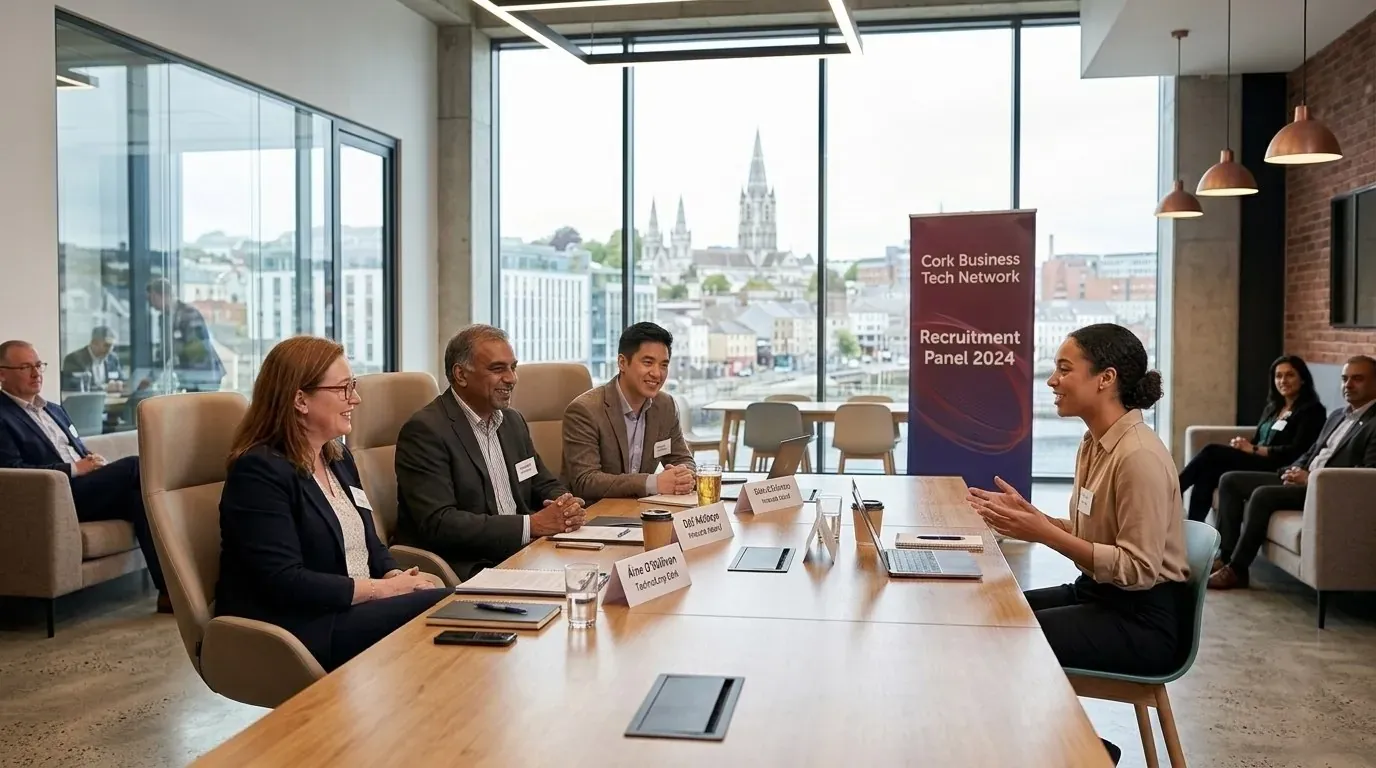
Irish job interviews balance technical proficiency with cultural and relational alignment. Employers evaluate whether a candidate communicates transparently, operates with modest team-first accountability, and demonstrates problem-solving through concrete examples (using the STAR method). Rigid memorization or aggressive self-promotion is viewed unfavourably.
1. The Core Misunderstanding: It Is a Dialogue, Not a Defense
International professionals entering Irish hiring processes often prepare for a rigorous examination: defending their credentials against adversarial questions or reciting memorized technical definitions.
When they arrive, they are greeted with informal warmth. The panel offers water, jokes about the morning rain, and asks about their journey to the office.
This is not a casual prologue to be rushed through; it is the first phase of evaluation. In Irish corporate culture, technical excellence is a baseline expectation, but interpersonal cohesion determines the hiring decision. As covered in our guide on navigating Irish workplace culture, hiring panels want to know what you will be like during a difficult sprint, how you handle mistakes, and whether you support your peers.
For official perspectives on hiring standards across Irish industry, review the graduate careers guidance published by gradireland. Before scheduling your next panel, rate your interview readiness using structured competency metrics.
2. The Mechanics of the Competency-Based Interview
Irish enterprises—particularly across high-demand employment sectors—rely heavily on structured competency interviews. Questions almost always open with:
- "Tell me about a time you resolved a disagreement with a project stakeholder..."
- "Can you give an example of when a production deliverable failed to meet its deadline?"
- "Describe a situation where you had to lead a cross-functional team without formal authority..."
The panel is not looking for general philosophy; they are scoring your answer against a predefined matrix of behaviors: collaboration, resilience, analytical thinking, and ethical judgment.
3. The STAR Method: Tailored for Irish Cultural Nuances
To deliver high-scoring answers without appearing arrogant or evasive, structure every response using the STAR technique:
- Situation (15% of your time): Set the context concisely. State the enterprise scope, the project objective, and the immediate constraint.
- Task (15% of your time): Define your specific responsibility. What was expected of you within the team?
- Action (50% of your time): Explain the practical steps you took. In Ireland, balance "I" and "We". Use "I" to claim ownership of decisions and engineering choices, but use "We" to acknowledge team contributions and consensus-building.
- Result (20% of your time): Provide measurable results (e.g., "reduced processing latency by 32%" or "delivered the audit report two days ahead of schedule"). Conclude with what the experience taught you.
- Situation — What International Candidates Do: Explains corporate politics in depth; The Irish Market Expectation: Concise 2-sentence background
- Task — What International Candidates Do: Focuses on high-level title authority; The Irish Market Expectation: Specific personal deliverable
- Action — What International Candidates Do: Says "I did everything alone"; The Irish Market Expectation: Balances personal action with team
- Result — What International Candidates Do: Generic ("The project went well"); The Irish Market Expectation: Quantified impact + lesson learned
- Tone — What International Candidates Do: Formal, defensive, authoritative; The Irish Market Expectation: Calm, reflective, self-aware
4. The Questions You Must Ask the Panel
At the end of the interview, the panel will ask: "Do you have any questions for us?"
Replying with "No, you covered everything" indicates disinterest. Asking only about salary or annual leave signals transactional thinking. Instead, ask questions that demonstrate curiosity about team workflow, regional dynamics, and long-term objectives:
- "How does this team balance rapid execution with cross-departmental consensus?"
- "What are the biggest operational challenges this department aims to solve in the next six months?"
- "For someone stepping into this role, what does success look like at the ninety-day mark?"
These questions reinforce your position as a thoughtful colleague.
5. Frequently Asked Questions (FAQ)
What do Irish employers value most in job interviews?
They value verifiable competence presented with personal humility. Clear communication, low ego, ability to admit learning curves, and collaborative problem-solving are essential.
How is a job interview structured in Ireland?
The standard interview lasts 45 to 60 minutes: five minutes of introductory small talk, thirty-five minutes of competency-based behavioral questions, and ten minutes for candidate inquiries.
How should international candidates talk about past overseas experience?
Frame your experience through recognized industry standards (e.g., ISO, GMP, IEEE) and explain the business scope simply. Focus on what you delivered rather than company prestige.
Prepare Your Career Transition with Confidence
Excelling in an Irish interview requires combining technical precision with cultural awareness.
- Audit your readiness: Rate your interview readiness using the Confidence Compass diagnostic tool.
- Practice with peers: Connect with experienced industry professionals through our Mentorship Programme.
- Explore open roles: Browse verified vacancies across Munster and Leinster on our External Opportunities directory.