Building authentic community connections as a newcomer in Ireland. Source: Cork English College
Overcoming newcomer isolation in Ireland requires shifting from solitary digital job searches to active, place-based community engagement. International arrivals build lasting social connections by participating in local volunteer initiatives, joining public library cultural groups, engaging with advocacy networks like Migrant Rights Centre Ireland, and enrolling in structured peer mentorship cohorts. These touchpoints build the emotional resilience and local social capital essential for long-term integration.
1. The Quiet Weight of the Empty Living Room
You have completed the bureaucratic marathon. Your Irish Residence Permit (IRP) appointment is finished, your PPS number is active, and you finally have keys to an apartment in Dublin, Cork, or Limerick.
On paper, the move is a success.
Yet on a wet Tuesday evening, sitting in an unfamiliar flat while the rain taps against the windowpane, a wave of profound isolation often arrives without warning. You realize that your entire social support system—the colleagues who understood your shorthand, the family members you visited on Sundays, the friends who knew your history—remains thousands of kilometers away.
In Ireland, newcomers often find that while people are exceptionally polite on the street ("How are ya now?"), turning casual warmth into close, enduring friendship feels challenging.
Feeling disconnected during your first year is not a sign of personal failure. It is an expected, documented phase of cultural relocation.
In an economy characterized by severe talent demand across high-demand employment sectors, true career stability cannot happen in a social vacuum. Professional resilience requires human belonging.
Established organizations like Migrant Rights Centre Ireland provide essential migrant support resources to ensure workers understand their rights and feel supported.
Community connection is an essential pillar of health and dignity, reflecting the philosophy behind our approach.
To start connecting with peers and mentors across Ireland, explore our programs and discover how you can join a DGS program.
2. Deconstructing the Relocation Slump: The 90-Day Reality
Loneliness among international specialists is rarely discussed because professionals feel pressure to project strength and competence.
However, as outlined in our practical 90-day culture shock framework, human adaptation follows a predictable curve:
- The Tourist High (Weeks 1–4): Everything is novel. You explore city landmarks, sample local cafes, and enjoy the relief of arrival.
- The Social Deficit (Weeks 6–12): Routine sets in. The absence of deep community becomes acute. Small misunderstandings around navigating Irish workplace culture feel magnified.
- The Danger of Retreat: Without intentional intervention, newcomers often withdraw into insular expatriate online forums, compounding feelings of alienation.
Overcoming this slump does not require becoming an extrovert. It requires stepping into environments where connection forms around shared activities rather than awkward small talk.
3. Transition Matrix: Moving from Disconnection to Belonging
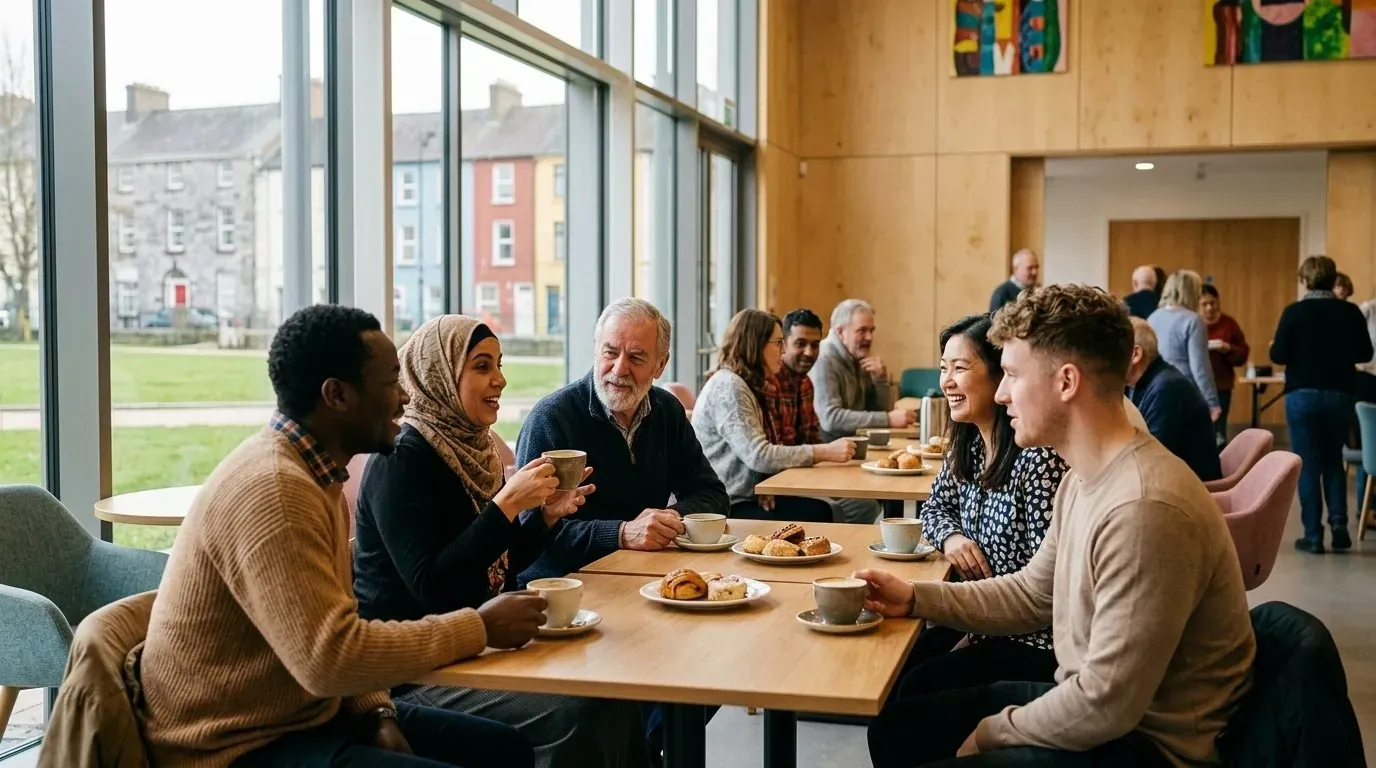
Informal community gatherings foster lasting belonging. Source: Coalition of Irish Immigration Centers
- Social Environment — The Isolated State (Phase 1): Confined to flat and remote laptop; Connected Community: Active presence in local civic hubs
- Professional Network — The Isolated State (Phase 1): Cold, unreturned LinkedIn outreach; Connected Community: Warm introductions via mentors
- Cultural Understanding — The Isolated State (Phase 1): Guessing at indirect communication; Connected Community: Fluent in decoding Irish business norms
- Support System — The Isolated State (Phase 1): Solitary anxiety; high stress; Connected Community: Peer cohorts & migrant resources
- Local Civic Roots — The Isolated State (Phase 1): Temporary visitor mindset; Connected Community: Long-term community anchoring
4. 5 Practical Ways to Build Your Community in Ireland
To transition from isolation to active belonging across Irish cities and regional hubs, put these five proven strategies into action:
1
Engage with Public Libraries and Community Centres
1.Engage with Public Libraries and Community Centres
Irish public libraries (such as the Central Library in Dublin’s Ilac Centre or the City Library on Grand Parade in Cork) are vibrant civic spaces. They host free language exchanges, book clubs, creative writing circles, and digital workshops where you can meet locals and newcomers in a low-pressure setting.
2
Participate in Skills-Based Civic Initiatives
2.Participate in Skills-Based Civic Initiatives
One of the fastest ways to build friendships is to work alongside others toward a common goal. Get involved with local tidy towns groups, sports clubs (such as local GAA social initiatives or Parkrun), or explore opportunities.
3
Join Structured Peer Mentorship Cohorts
3.Join Structured Peer Mentorship Cohorts
Avoid navigating the professional landscape in isolation. Join structured cohorts like the DGS mentor network, where you are paired with an established professional who acts as both an industry sounding board and a supportive cultural guide.
4
Attend Regional Industry and Social Meetups
4.Attend Regional Industry and Social Meetups
Step outside your apartment and attend low-pressure gatherings. Apply the tactics in our guides on networking in Cork for newcomers and staying visible during winter to cultivate genuine relationships over morning coffee.
5
Anchor in Shared Learning and Upskilling
5.Anchor in Shared Learning and Upskilling
Take a short evening course at a local Education and Training Board (ETB) or university extension centre. Learning alongside peers creates natural conversation topics, breaking down social hesitation effortlessly.
5. From Isolation to Leadership: The Ripple Effect
When newcomers build authentic local roots, the benefits extend far beyond personal wellbeing.
In both instances, career breakthroughs were preceded by intentional community integration.
"Integration is not something you do alone in front of a screen," notes Ms. Haidary, Trustee and Governance Lead. "It happens when you share a cup of tea, volunteer for a local project, and realize that your voice and experience matter to the people around you. Ireland becomes home the moment you feel seen and valued in your local community."
By stepping onto the Two-Way Bridge, newcomers turn the uncertainty of arrival into an enduring foundation for personal and professional growth.
6. Frequently Asked Questions (FAQ)
Why do skilled newcomers feel sudden isolation after moving to Ireland?
The novelty of arrival typically fades after the first month. Newcomers often experience disconnection when professional status resets, family networks are distant, and indirect Irish social conventions prove difficult to navigate without guidance.
Where can immigrants access trusted support and community resources in Ireland?
Key resources include Migrant Rights Centre Ireland (MRCI) for workplace rights and advocacy, local county Volunteer Centres, public library cultural initiatives, and community mentorship networks supported by Domhan Green Society.
How does building social connections improve career outcomes for migrants?
In Ireland, a significant portion of senior hires and project roles are filled through referral networks. Community involvement provides emotional balance, combats burnout, and creates natural professional introductions that bypass automated application screening.
Take Your First Step Toward Connection
You do not have to walk this path alone. Find your community and build your future in Ireland.
- Get involved today: Explore our programs to join a DGS program and meet peers and mentors across Ireland.
- Benchmark your career readiness: Take the Confidence Compass diagnostic to map your professional skills to Irish market standards.
- Give back and connect: Discover how to volunteer your skills or become a mentor or mentee.
- For employers: Learn how your business can support community wellbeing by discovering how to partner with DGS on corporate inclusion.